Do we need large plants to get high soybean yields?
Do we need large plants to get high soybean yields?
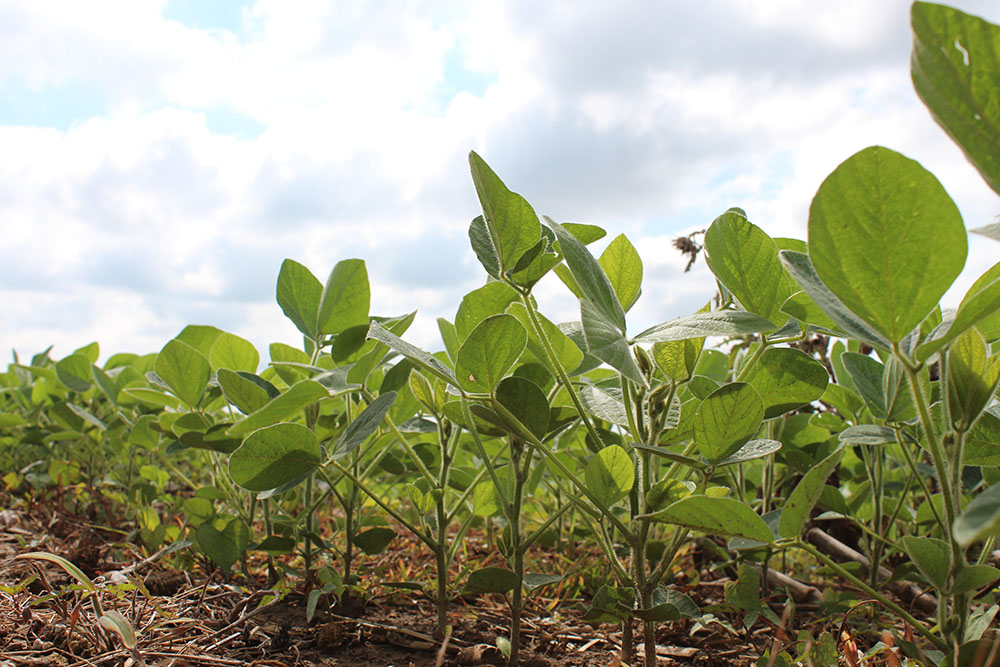
At first glance, the answer to this question seems obvious – of course, larger plants will produce higher yields. Unfortunately, it’s just not that simple.
Soybean plants that grow rapidly will be large and produce high yields. Plenty of water, adequate nutrition, and no problems with weeds, insects or diseases are characteristics of a high-yield environment that results in rapid plant growth and large plants. Rapid growth produces large plants and high yields.
High yields are usually associated with large numbers of pods and seeds, which are related to the crop growth rate between Growth Stage R1 and R5. A high growth rate during this critical period produces lots of pods and seeds and high yields (assuming there is no stress during seed filling (Growth Stage R5 to R7).
The opposite of this relationship is also true. Stress during vegetative growth and the R1 to R5 period will slow growth, reduce plant size, the number of pods and seeds, and yield.
But the growth rate - plant size relationship is not the whole story. Plants can also be large by growing for a long time. There are always two ways to get large plants: they can grow rapidly, or they can grow for a long time, or any combination of the two. Understanding how crops grow and produce yield is never simple.
Variation in variety maturity results in differences in the length of the vegetative growth phase (planting to R5) and plant size. Late-maturing varieties have a longer vegetative growth phase and, even though they may grow at the same rate as earlier varieties, they will produce larger plants because they grow for longer. We compared varieties from Maturity Groups (MG) 00, I, III, and V in irrigated experiments for two years on Spindletop Farm near Lexington, KY, using a mid-May planting date. The length of vegetative growth (from planting to growth stage R5) varied from 55 days for MG 00 to nearly double that (90 days) for MG V (Fig. 1). The weight of the vegetative plant at Growth Stage R5 (beginning of seed fill) was closely associated with these differences in time, but yield was not. The differences in plant size did not necessarily translate into differences in pod and seed number or yield because the differences were due to time, not to the rate of growth.
Delayed planting also shortens the vegetative growth phase, resulting in smaller plants. For example, delaying planting from mid-May to late-June on Spindletop Farm shortened the vegetative growth phase from 73 to 60 days in a Maturity Group II variety and from 87 to 68 days in a Maturity Group IV variety. With less time to grow, the plants are smaller.
Plant size also plays an important role in the interception of solar radiation. Solar radiation provides the energy to drive photosynthesis and plant growth, so the maximum growth rate and yield require intercepting all the solar radiation. Solar radiation that makes it to the ground (is not intercepted) is wasted; in fact, it’s worse than wasted because it helps weeds grow. The plant growth rate is related to the proportion of the solar radiation intercepted by the leaves, so the plant must be large enough to provide complete ground cover by at least R1 (or shortly thereafter) to get maximum yield. Reaching complete ground cover earlier will contribute to better weed control, but it’s not necessary for maximum yield (assuming no problems with weeds). We can circumvent the size issue when it comes to solar radiation interception by using narrower rows.
The effects of variety maturity or planting date on plant size and productivity is complicated by the fact that changing maturity or planting date puts critical growth stages (flowering, seed set and seed filling)in a different environment. The MG 00 variety that we used in our research reached Growth Stage R5 on July 19, compared with August 23 for the MG V variety with a mid-May planting date. The early variety probably received more solar radiation during seed set and seed filling than the late variety, but which one got more rainfall could vary from year to year. Changes in the environment probably have a greater effect on the lower yields in late plantings than the smaller plants, assuming narrow rows are used to provide complete ground cover.
Do we need large plants to get high soybean yields? Yes and no! It all depends on why they are large. Rapidly growing plants are large and have the potential to produce high yields. Plants that grow for a longer time are also large, but, in this case, large does not necessarily mean higher yield. Always remember – “imagination is more important than knowledge. Knowledge is limited. Imagination encircles the world.” Albert Einstein, 1879 – 1955, theoretical physicist.

Citation: Egli, D., 2026. Do We Need Large Plants to Get High Soybean Yields? Kentucky Field Crops News, Vol 2, Issue 03. University of Kentucky, March 13, 2026.
Dr. Dennis Egli, UK Professor Emeritus
859-218-0753 degli@uky.edu
Related Information