Corn N biologicals and fertilizer additives: Worth it this year?
Corn N biologicals and fertilizer additives: Worth it this year?
Corn nitrogen (N) management expense is rising as prices for N fertilizers increase. The corn N marketplace contains several biologicals that promise to replace a portion of corn’s total fertilizer N need. Additionally, there are chemical N fertilizer additives and new N sources that are intended to inhibit N loss; either ammonia volatilization from urea-based materials or nitrate denitrification from wet soils. So, should the corn producer use one or more of these products, or just keep adding the insurance lb N/acre as they have done in the past? There may be some operational/economic reasons to do one or the other, but our experience indicates that some choices are clearly better than others.
Biologicals – Replacing, economically, some of corn’s fertilizer nitrogen (N) need with biological N fixation (BNF) is becoming a major goal in commercial corn production. With BNF, microbes fix atmospheric N as ammoniacal N, thereby providing N nutrition to the crop. Several BNF products have reached the marketplace. The PROVEN 40™ BNF product from Pivot Bio has been used in no-till corn planted into a heavy cereal rye cover crop (Nalley and Lee, 2024). The first year treatments consisted of two N rates, 140 and 180 lb N/acre, both without and with the BNF product. Corn treated with PROVEN 40™ averaged 11 bu/acre greater yield, regardless of the N rate. Unexpectedly, there was no interaction between N rate and PROVEN 40™ use on corn yield (a greater benefit to the BNF product at 140 lb N/acre was expected). The positive yield impact due to PROVEN 40™ was probably not due to BNF. In the second year, no-till corn followed rye killed either five or two weeks before planting (Lee et al., 2025), resulting in different levels of decomposing rye residue at planting. Three N rates (170, 215 and 260 lb N/acre) were applied, both without and with PROVEN 40™. Lower rye residue amounts caused by killing rye five weeks before planting improved corn yield response to the higher N rate treatments, but there was no impact of PROVEN 40™. With heavier rye residue levels after killing rye only 2 weeks before planting, there was a trend for greater yield (5 to 20 bu/acre) with use of PROVEN 40™, though that trend was not related to the applied N rate. Again, results indicate that BNF improved crop yield but not crop N nutrition.
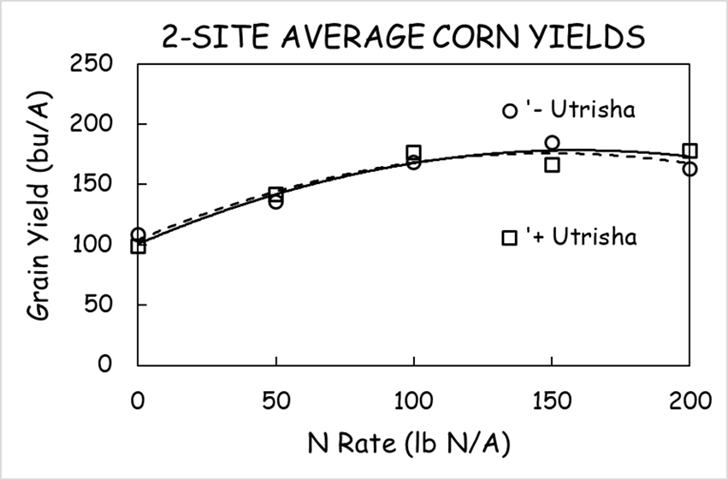
The BNF Utrisha-N™ (Corteva) was evaluated on two soils (Crider, Sadler), at each of five fertilizer N rates (0, 50, 100, 150 and 200 lb N/acre) at the University of Kentucky Research and Education Center (UKREC) near Princeton. Figure 1 shows the yield response to N rate, both without and with Utrisha-N™. Across locations, there was a good yield response to fertilizer N rate but little to no response to Utrisha-N™, even at the lower N rates where some benefit to a BNF product is expected.
Generally, there has been little response to BNF products. In the North Central region, 61 site-years of field work with corn, spring wheat, sugar beet and canola, in 10 states (including Kentucky), resulted in only two site-years with a positive yield response to a BNF product (Franzen et al., 2023). More important than the general lack of yield benefit to BNF product use is that we can’t predict site conditions for a BNF product to work, and given the low probability of benefit, response predictability is critical to grower success with these products.
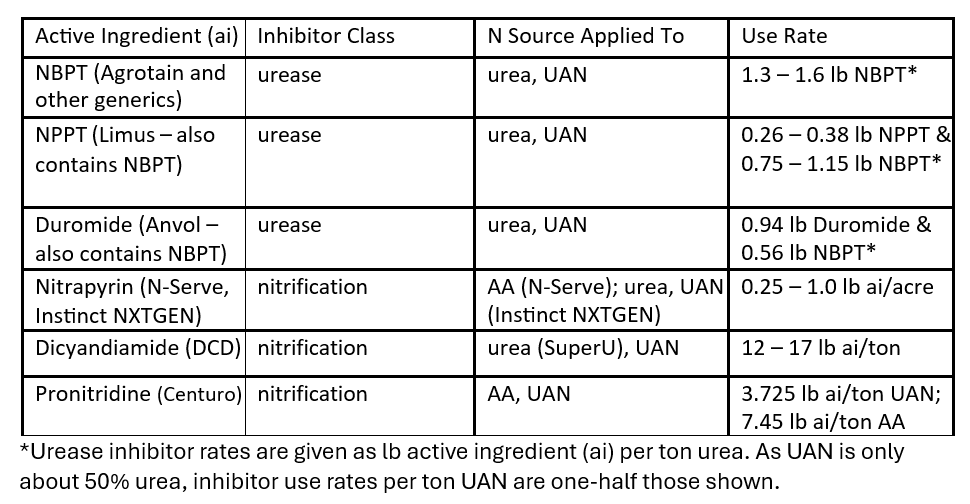
N Stabilizers/Loss Inhibitors - These are added to/with fertilizer prior to/at application and are integral to N source behavior and value/cost. Generally, inhibitors used in corn N management come in two classes, urease-volatilization inhibitors and nitrification inhibitors (Table 1). With a urease inhibitor, both active ingredient and use rate are chosen carefully. There are many products that claim to inhibit volatilization. Urease inhibitor products tend to be more numerous than effective.
Nitrification inhibitor use might be needed when the full N rate is applied pre-plant, field soil drainage class is less than moderately well-drained, and/or the greater time between N application prior to planting and significant crop N uptake (V5).
To calculate the amount of a product to be added to a fertilizer material for effective inhibition, the user will need to know the active ingredient concentration in the product and, if the product is a liquid, the product density (lb/gallon). Example: Product XYZ contains 30% NBPT and a density of 10 lb/gallon. To deliver 1.5 lb ai/ton urea, you need to apply 1.5/(0.3 x 10) = 0.5 gallon (2 quarts)/ton. This information isn’t always easily found on the product label. Consult the product safety data sheet, if available. If ai concentration and density info can’t be determined, found or provided, then an alternate product should be considered.
Table 1. Inhibitors found effective under field conditions in peer-reviewed research.
A field study at the UKREC compared corn yield after fertilization with several N sources/source-stabilization combinations at 75 lb N/acre sidedressed to no-till corn (Figure 2). Besides the unfertilized control, there were ammonium nitrate, urea, urea treated with Agrotain® (NBPT) or Nutrisphere-N® (maleic-itaconic copolymer), SuperU® (urea co-prilled with DCD (dicyandiamide) and NBPT), and ESN® (Environmentally Smart Nitrogen, a polymer coated urea, PCU) N treatments. The PCU, ESN®, has been available since 2007.
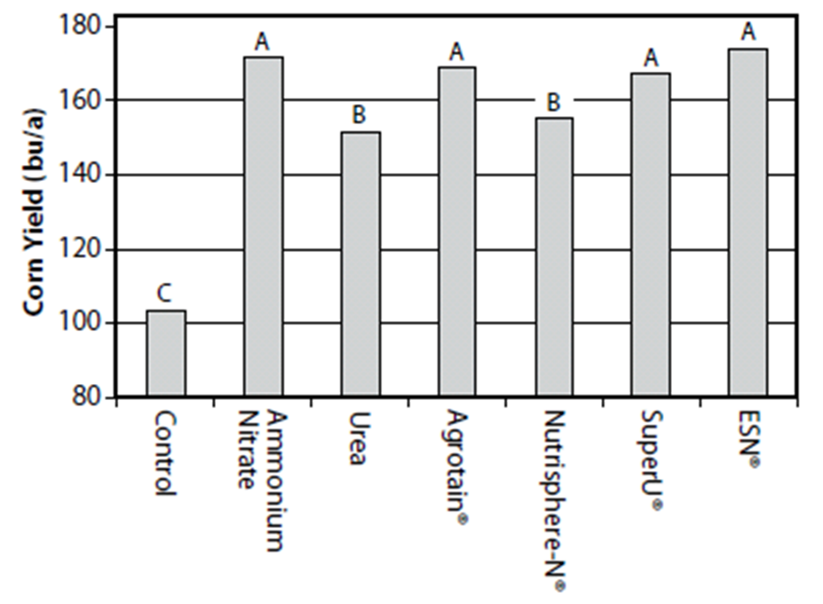
The low yield of the check confirms that the crop was facing serious N deficiency. Corn yield differences between the ammonium nitrate (no volatilization loss potential) treatment, and the corn fertilized with urea (Figure 2) can be attributed to N volatilization. Then, comparing the other treatments in the study; Agrotain®, SuperU®, and ESN® produced yields equal to that from ammonium nitrate, while Nutrisphere-N® use gave a yield that was the same as that observed with unprotected urea (Figure 2). Under these conditions, high N volatilization loss caused corn yield to be significantly lower with Nutrisphere-N® use as compared to yields with use of the other products tested. More comparisons, made in different years and locations across Kentucky, also indicate Nutrisphere-N® is not as effective as other products in reducing N volatilization (or denitrification) N loss (Schwab and Murdock, 2010).
There are alternatives to inhibitor purchase when a corn grower desires to reduce N loss and improve fertilizer N use efficiency. Denitrification (and leaching) losses that can follow nitrification of ammoniacal N to nitrate-N might be avoided by delaying the larger portion of corn’s fertilizer N, especially on wetter soils. Generally, corn N rate and timing are linked – the earlier the first fertilizer N is applied, the more N that is needed. Our springs are getting warmer and are often wetter. More corn is planted earlier than before. These conditions especially drive losses of pre-plant and at-plant N before the crop has grown enough of a root system to effectively capture fertilizer N. So, with moderately well-drained to poorly drained soils (all soils except well-drained soils), the total N rate can be decreased by 30 to 50 lb N/acre if at least two-thirds of the fertilizer N is applied 4 to 6 weeks after planting (corn growth stage V3 to V8). This practice is most important on a producer’s wettest natured soils.
Urease-driven volatilization losses are lower in pre-plant/at-plant N applications prior to May 1 because environmental conditions are generally cooler, and there is a greater probability of sufficient rainfall (0.25 inch or more) to incorporate urea. This is most valuable for well-drained soils. A corn grower could also avoid using urea or UAN, favoring anhydrous ammonia, ammonium nitrate (AN) or ammonium sulfate (AS), though anhydrous requires injection and both AN and AS are often more expensive than urea. Producers can also place urea/UAN below the soil surface with tillage after pre-plant application or injection of at-plant and sidedress UAN. If not injecting, UAN efficiency in a topdress application can be substantially improved by dribble banding rather than broadcasting, especially when crop/cover crop residues are high. And if the option exists, consider the near-term weather – apply topdressed UAN within 72 hours of a forecast rain event of 0.25 inch or more.
We conclude that most all biologicals promising better N use efficiency are still a ‘work in progress’ – difficult to justify at present. But corn producers still need to deal with current economics (and weather challenges) as they consider corn N management. The old concept of an additional 20 to 40 lb “insurance” N/acre is being challenged by the current N:corn price ratio, currently significantly greater than the usual value of 0.1 ($0.40 per lb N/$4.00 per bu). Kentucky corn producers can use several products to improve fertilizer N efficiency, especially the well-researched volatilization and nitrification-inhibiting products. These sources/source-stabilization products are beneficial in specific situations – an understanding of how and when these products work is important. Growers should realize these products are designed to conserve N. Benefits to use of these products are seen only when the total N application rate is reduced by the amount of N to be saved by using a good inhibitor (Table 1) or an N source that inhibits losses (Figure 2). Alternatively, some producers might also change one or more N management practices (timing or placement) to better ‘insure’ corn N nutritional adequacy. Many different scenarios, and associated N rate recommendations, are found in the newest version of AGR-1.
Franzen, D., J. Camberato, E. Nafziger, D. Kaiser, K. Nelson, G. Singh, D. Ruiz, E. Lentz, K. Steinke, J.H. Grove, E.L. Ritchey, L. Bortolon, C. Rosen, B. Maharjan and L. Thompson. 2023. Performance of Selected Commercially Available Asymbiotic N-fixing Products in the North Central Region. SF2080. NDSU Extension, Fargo, ND. https://www.ndsu.edu/fileadmin/snrs/Files/SF2080_Performance_of_Selected_N-fixing_Products.pdf
Lee, C., C. Nye and J. Bush. 2025. Evaluating impact of N uptake of corn with PROVEN 40 seed treatment with various N rates and cover crop termination. 2024 Corn Research Report. Martin-Gatton College of Agriculture, Food and Environment. Grain and Forage Center of Excellence.
Nalley, R., and C.D. Lee. 2024. Corn yield response to Pivot Bio PROVEN40. 2023 Corn Research Report. Martin-Gatton College of Agriculture, Food and Environment. Grain and Forage Center of Excellence.
Schwab, G.J., and L.W. Murdock. 2010. Nitrogen Transformation Inhibitors and Controlled Release Urea. AGR-185. University of Kentucky Cooperative Extension Service, Lexington, KY.
| Citation: Grove, J., Ritchey, E., 2025. Corn N Biologicals and Fertilizer Additives: Worth It This Year? Kentucky Field Crops News, Vol 1, Issue 10. University of Kentucky, October 10, 2025. |

|

|
Related Information